How to Apply for a Massachusetts LTC (Step-by-Step Guide)
License to Carry (LTC) Application Process – Massachusetts
Thinking about getting your License to Carry (LTC) in Massachusetts? Whether you're new to firearms or taking the next step in personal protection, this guide walks you through the current application process.
Step 1: Take a Certified Firearms Safety Course
Massachusetts law requires all LTC applicants to complete a state-approved firearms safety course before applying.
What’s included in the course:
- Firearm safety rules and safe handling
- Safe storage and transportation requirements
- Massachusetts firearms laws and legal responsibilities
- Classroom-based instruction with practical safety exercises
- Written exam required
Important: Most applicants complete the training course first, then submit their application through the state portal.
🔗 Looking to enroll? Register here for our certified LTC course
Step 2: Prepare Your Information
Before starting your application, make sure you have:
- Certificate of completion from your safety course
- A valid photo ID (typically a driver’s license)
- Proof of residence (if required by your local department)
- Your personal history information for the application
Step 3: Submit Your Application Online (MIRCS Portal)
Massachusetts uses the Massachusetts Instant Record Check System (MIRCS) Unified Portal for firearms licensing applications.
Start your application here:
Massachusetts Firearms Licensing Portal (MIRCS)
You will create an account, complete your application, and submit it online before working with your local police department.
After submitting online, you will:
- Be contacted by your local police department
- Schedule an appointment (if required)
- Complete fingerprinting and photograph
- Pay the application fee ($100, valid for 6 years)
Tip: Creating your MIRCS account before attending your class can help you move forward quickly once you receive your certificate.
Step 4: Local Review and Background Check
Your local licensing authority will review your application, conduct a background check, and determine eligibility.
Processing time: Varies by department; often 4–12 weeks or longer depending on application volume.
You will receive: Your LTC by mail or a notification to pick it up.
Step 5: Maintain and Renew Your LTC
Once your LTC is issued:
- Carry your license when carrying a firearm
- Renew your license at least 90 days before expiration
- Notify your licensing authority if you move
Continuing education is strongly recommended. Consider advanced training such as:
- NRA Range Safety Officer (RSO)
- Refuse To Be A Victim® seminar
Ready to Start?
If you're ready to begin your journey as a responsible firearms owner, the first step is completing your safety training.
✅ Register for a Massachusetts LTC Course
📞 Questions? Call 978-225-0804
Last Updated: April 5, 2026
Parents’ Guide to Firearm Safety
 Parents play a critical role in developing safe habits and are ultimately responsible for their children’s safety. Because isolated lessons can be quickly forgotten, repetition and reinforcement help children remember and apply safety procedures.
Firearm safety education should not be a one-time conversation. Children benefit most when parents consistently reinforce clear, age-appropriate safety messages both inside and outside the home.
The Parents’ Responsibility
In any home where firearms are present, a child’s safety rests squarely with the parents or guardians. This responsibility extends beyond your own household.
According to federal statistics, firearms are present in approximately half of all U.S. households. Even if your family does not own a firearm, your child may encounter one at a friend’s home, a neighbor’s house, or another environment outside your control.
Children must know what to do if they encounter a firearm anywhere, and it is the parent’s responsibility to provide that education.
Talking With Your Child About Firearm Safety
There is no single “right age” to begin discussing firearm safety. The first time a child shows interest — even through toy firearms or media exposure — is an appropriate time to introduce safety concepts.
Open, honest discussion is more effective than simply telling a child to avoid firearms. Clear explanations help remove mystery and reduce curiosity-driven risk.
Any safety rules established for your child should also apply to visiting friends to reduce peer pressure and unsafe behavior.
Toy Firearms vs. Real Firearms
Especially with younger children, it is important to explain the difference between entertainment and reality. Firearms are often portrayed unrealistically in movies, television, and video games.
If toy firearms are present, use them as teaching tools to demonstrate safe handling concepts while clearly explaining how real firearms differ and why they must never be touched without adult supervision.
What Should You Teach Your Child?
For children who are not yet ready for formal firearms training, the NRA Eddie Eagle GunSafe® Program provides a simple, age-appropriate message:
- STOP!
- Don’t Touch.
- Leave the Area.
- Tell an Adult.
 The first two steps — Stop and Don’t Touch — are the most critical. Reinforcing these steps helps counter the natural impulse to investigate unfamiliar objects.
“Leave the Area” emphasizes physical separation from danger, and “Tell an Adult” reinforces the importance of seeking help from a trusted authority figure when a parent or guardian is not immediately available.
Additional Resources
A short Eddie Eagle educational video is available below for parents who wish to reinforce these concepts visually with their children:
Watch the Eddie Eagle firearm safety video
Questions or Training Requests
If you would like guidance on age-appropriate firearm safety education, classroom presentations, or family-focused training, please contact us.
Contact Seacoast Firearms Training
NRA Rules for Safe Firearm Handling
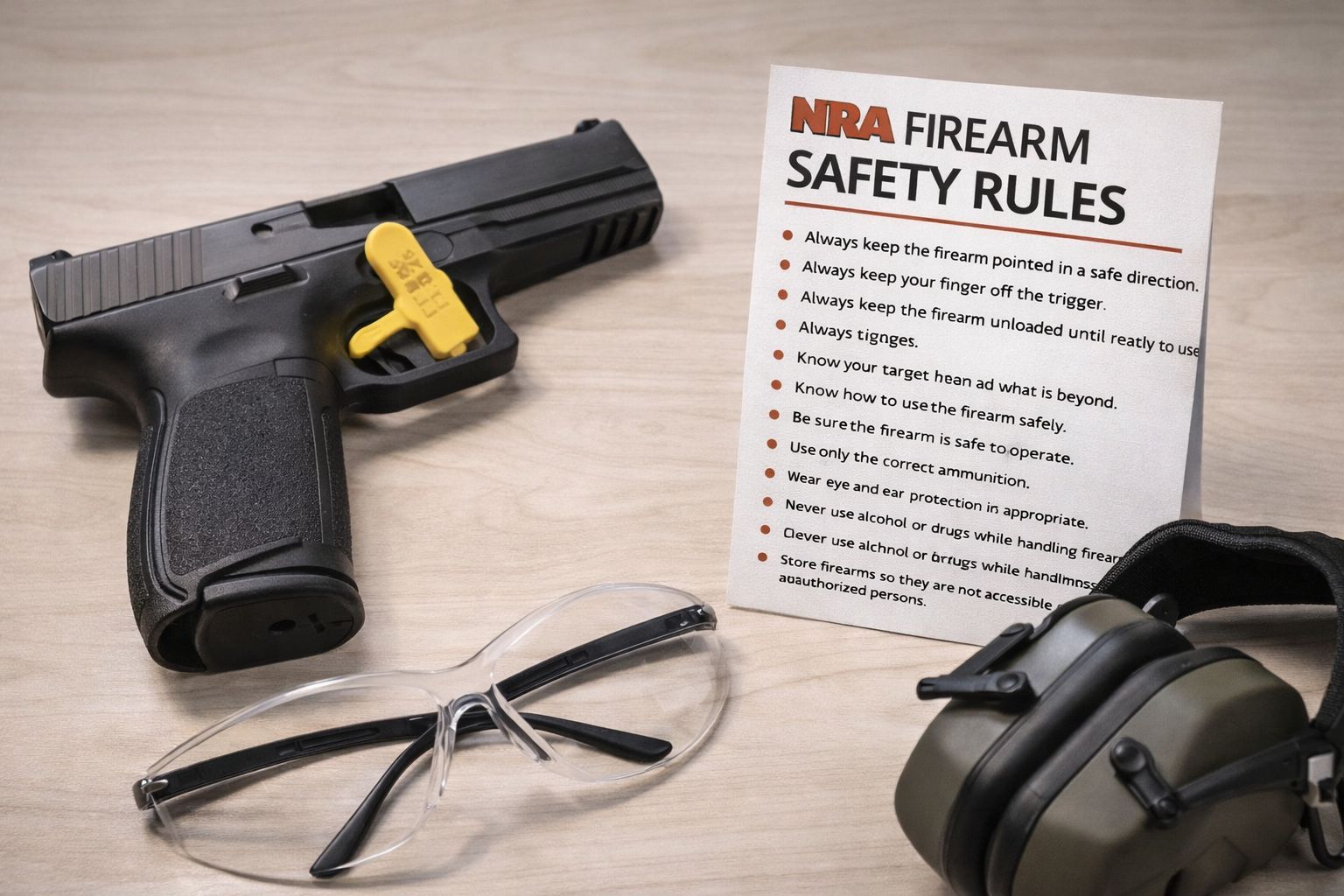 Safety is the foremost priority when handling firearms. Following the NRA’s firearm safety rules promotes responsible ownership, safe operation, and accident prevention. These rules apply to all experience levels and should be practiced at all times.
The NRA Rules for Safe Firearm Handling
| 1. |
Always keep the firearm pointed in a safe direction. |
| |
Control where the muzzle is pointed at all times. A safe direction means that even if the firearm were to discharge, no injury or damage would occur. |
| |
| 2. |
Always keep your finger off the trigger until you are ready to shoot. |
| |
Keep your finger indexed along the frame until your sights are on target and you have made the decision to fire. |
| |
| 3. |
Always keep the firearm unloaded until ready to use. |
| |
Immediately verify the firearm’s condition when handling it. Remove the magazine, open the action, and visually and physically check the chamber. Personal protection and home defense constitute a lawful “use.” |
Additional NRA Safety Rules
| 4. |
Know your target and what is beyond. |
| |
Be certain of your target and what lies beyond it. Firearms projectiles can penetrate walls, trees, and other barriers. |
| |
| 5. |
Know how to use the firearm safely. |
| |
Read the owner’s manual and understand how your firearm operates. Mechanical safeties are not substitutes for safe handling. |
| |
| 6. |
Ensure the firearm is safe to operate. |
| |
Firearms require regular inspection, cleaning, and proper maintenance. If a firearm does not function correctly, consult a qualified gunsmith. |
| |
| 7. |
Use only the correct ammunition. |
| |
Use ammunition specifically designed for your firearm. The correct caliber or gauge is typically marked on the barrel. |
| |
| 8. |
Wear eye and ear protection as appropriate. |
| |
Hearing and eye protection reduce the risk of injury from noise, debris, and gas emissions. |
| |
| 9. |
Never use alcohol or impairing substances. |
| |
Never handle or use firearms while under the influence of alcohol, prescription medication, or other substances that impair judgment. |
| |
| 10. |
Store firearms securely. |
| |
Store firearms so they are inaccessible to unauthorized users. Use locking devices and follow safe storage practices appropriate to your household. |
Firearm Maintenance Guide
Regular cleaning and maintenance are essential for safe and reliable firearm operation. Proper care extends service life, preserves value, and reduces the likelihood of malfunctions.
Firearms should be cleaned after use and before firing if they have been stored for an extended period. Moisture, debris, and degraded lubricants can affect function.
Before performing maintenance:
- Verify the firearm is unloaded
- Open the action
- Remove all ammunition from the workspace
A Note About Accidental and Negligent Discharges
The vast majority of unintentional discharges are the result of user error and are more accurately described as negligent discharges. Common contributing factors include failure to follow safety rules, improper maintenance, or incorrect handling.
True mechanical malfunctions are rare but possible. Firearm safeties are mechanical devices and can fail — reinforcing why adherence to safety rules is always essential.
For questions about training, safety education, or firearm maintenance instruction, please contact Seacoast Firearms Training.