
Massachusetts Firearms Laws Overview (2026 Update)
LTC, FID, Training, Serialization & Compliance After the 2024 Law Changes
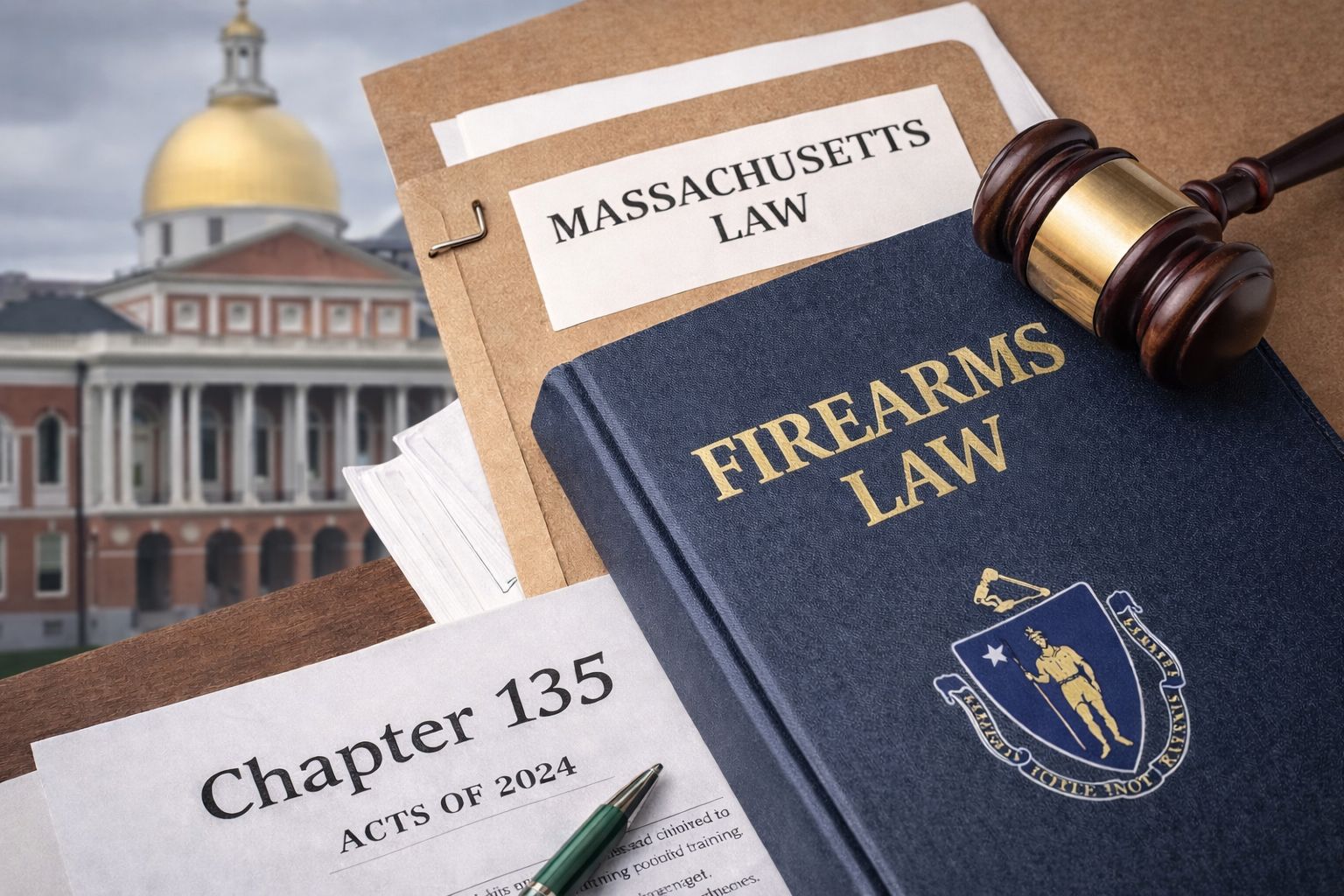
Massachusetts has some of the most complex and restrictive firearms laws in the United States. Whether you are a new firearm owner, a first-time License to Carry (LTC) applicant, or a long-time license holder, staying current with the law is essential.
This page provides an educational overview of Massachusetts firearms laws as of April 2026, including updates under Chapter 135 of the Acts of 2024.
Important (April 2, 2026): While new training requirements exist in law, certain components—such as live fire—are not currently being enforced pending final state guidance.
1. License to Carry (LTC) and Firearms Identification (FID)
License to Carry (LTC)
- Purchase, possess, and carry handguns
- Possess rifles and shotguns
- Carry concealed in public (subject to restrictions)
- Possess large-capacity firearms and magazines only if lawfully owned prior to September 13, 1994, or otherwise exempt
Important Practical Guidance: Open Carry
Massachusetts law does not explicitly prohibit open carry by LTC holders. However, open carry is strongly discouraged.
Massachusetts is a discretionary licensing state. Licensing authorities retain broad authority under M.G.L. c. 140 § 131(d) to suspend or revoke an LTC if a license holder is deemed unsuitable. Open carry frequently results in 911 calls, law enforcement stops, and administrative review, even when no criminal conduct occurs. Because many members of the public are unfamiliar with Massachusetts firearms law, open carry creates unnecessary legal and practical risk for otherwise lawful carriers.
Firearms Identification Card (FID)
- Possession of non-large-capacity rifles and shotguns
- Limited ammunition purchase
- No authority to carry handguns
- No authority to possess large-capacity firearms or magazines
Law references:
M.G.L. c. 140 § 129B
M.G.L. c. 140 § 131
2. Firearms Safety Training Requirements (Updated April 2, 2026)
- Completion of a Massachusetts-approved firearms safety course is required
- A written exam is required as part of the training process
- A certificate of completion is required to apply for an LTC or FID
Live Fire Requirement:
- Included in law under M.G.L. c. 140 § 131P
- Not currently being enforced due to lack of implementation guidance
- No statewide curriculum or qualification standards have been issued
Additional Context (April 2, 2026):
Discussion at the April 2, 2026 Firearm Control Advisory Board (FCAB) meeting indicated that the implementation timeline for the live fire component remains under development. As of this time, no statewide curriculum or qualification standard has been issued, and the requirement is not currently being enforced.
Important Note:
There is currently inconsistency at the local level, as licensing authorities may interpret evolving requirements differently while awaiting formal statewide guidance.
Law references:
M.G.L. c. 140 § 131P
Chapter 135 of the Acts of 2024
3. Safe Storage Laws
- All firearms must be stored in a locked container, or
- Equipped with a tamper-resistant mechanical locking device
- Firearms must be secured in a manner that prevents access by unauthorized users, especially minors.
- Failure to properly secure a firearm is a criminal offense, even if no injury occurs.
Law references:
M.G.L. c. 140 § 131L
4. Magazine Capacity Limits
- A large-capacity feeding device is defined as:
- More than 10 rounds (rifles/pistols)
- More than 5 rounds (semi-automatic shotguns)
- Pump-action and break-action shotguns are not subject to the semi-automatic limit.
Law references:
M.G.L. c. 140 § 121
5. Assault-Style Firearms Restrictions
Massachusetts continues to prohibit the sale, transfer, and new possession of assault-style firearms based on model names, features, and design lineage.
Grandfathering applies only to firearms lawfully possessed prior to the applicable statutory cutoff dates.
Approved Firearms Roster:
https://www.mass.gov/lists/approved-firearms-rosters
Restrictions apply based on features, models, and statutory definitions.
Law references:
M.G.L. c. 140 § 121
M.G.L. c. 140 § 131M
6. Firearm Transportation
- Firearms must be unloaded during transport unless lawfully carried under an LTC
- Ammunition must be removed from the firearm
- A loaded firearm in a vehicle is permitted only under LTC authority and immediate control
- Open carry in a vehicle is prohibited
Law references:
M.G.L. c. 140 § 131C
M.G.L. c. 140 § 131L (Safe Storage)
Note: M.G.L. c. 140 § 131G was repealed by Chapter 135 of the Acts of 2024.
7. Reciprocity and Interstate Travel
Massachusetts does not recognize out-of-state carry permits.
Federal law provides limited interstate transport protections when firearms are unloaded, locked, and inaccessible.
Federal law reference:
18 U.S.C. § 926A
8. Extreme Risk Protection Orders (ERPO)
Courts may issue ERPOs to temporarily remove firearms from individuals deemed a danger to themselves or others.
Law references:
- M.G.L. c. 140 § 131R - Extreme Rick Protection Orders
- M.G.L. c. 140 § 131S – Petition and Court Process
- M.G.L. c. 140 § 131T – Hearing and Issuance Standards
- M.G.L. c. 140 § 131U – Law Enforcement Authority
- M.G.L. c. 140 § 131V – Surrender and Storage of Firearms
- M.G.L. c. 140 § 131W – Return of Firearms
- M.G.L. c. 140 § 131X – Penalties
- M.G.L. c. 140 § 131Y – Forms and Reporting
9. Unserialized Firearms (“Ghost Guns”)
Massachusetts law now explicitly criminalizes the manufacture, possession, transfer, or importation of untraceable firearms and certain components.
Possession of an untraceable firearm may constitute prima facie evidence of a violation, subject to limited defenses.
Law reference:
Chapter 135, §§ 18–23
10. Firearm Serialization and Registration
Chapter 135 establishes new statewide systems for firearm serialization and electronic registration.
- All firearms must be registered through a new electronic system
- The system must be operational within one year of the Act’s effective date
- Existing license holders will receive formal notice of requirements
Failure to comply may result in criminal penalties.
11. Prohibited Locations and Carry Restrictions
Firearms are prohibited in certain locations, including:
- Government buildings and court facilities
- Polling places and ballot storage sites
- Designated municipal properties
Proper secure vehicle storage remains a recognized legal defense when performed correctly.
12. Suppressors and Prohibited Devices
Suppressors remain prohibited for civilian ownership in Massachusetts regardless of federal registration.
Law reference:
M.G.L. c. 269 § 10
Legal Disclaimer
Educational Use Only — Not Legal Advice
This page is provided for general educational purposes only and does not constitute legal advice. Firearms laws are subject to change through regulation and court interpretation.
Readers are responsible for verifying current law through official sources and consulting qualified legal counsel for advice specific to their situation. This information is subject to change. Always verify with official sources.
Stay Legal, Stay Informed
Register for our Massachusetts Basic Firearms Safety Course
Refuse To Be A Victim Seminar® | NRA Range Safety Officer Course
Last Updated: April 5, 2026